

The pressure shows up elsewhere.
It shows up in the spaces between those systems. Between intake and coding, between coding and billing, between authorization and scheduling. Each function may work independently, but the handoffs create drag.
During a recent operational review at a regional health system, denial-related rework was consuming close to 20 percent of billing staff capacity. The coding accuracy was acceptable. Documentation existed. The issue was sequencing. Claims were validated after submission instead of before it.
Claims went out. Denials returned. Staff corrected preventable errors.
No single system failed.
But the workflow as a whole wasn’t aligned.
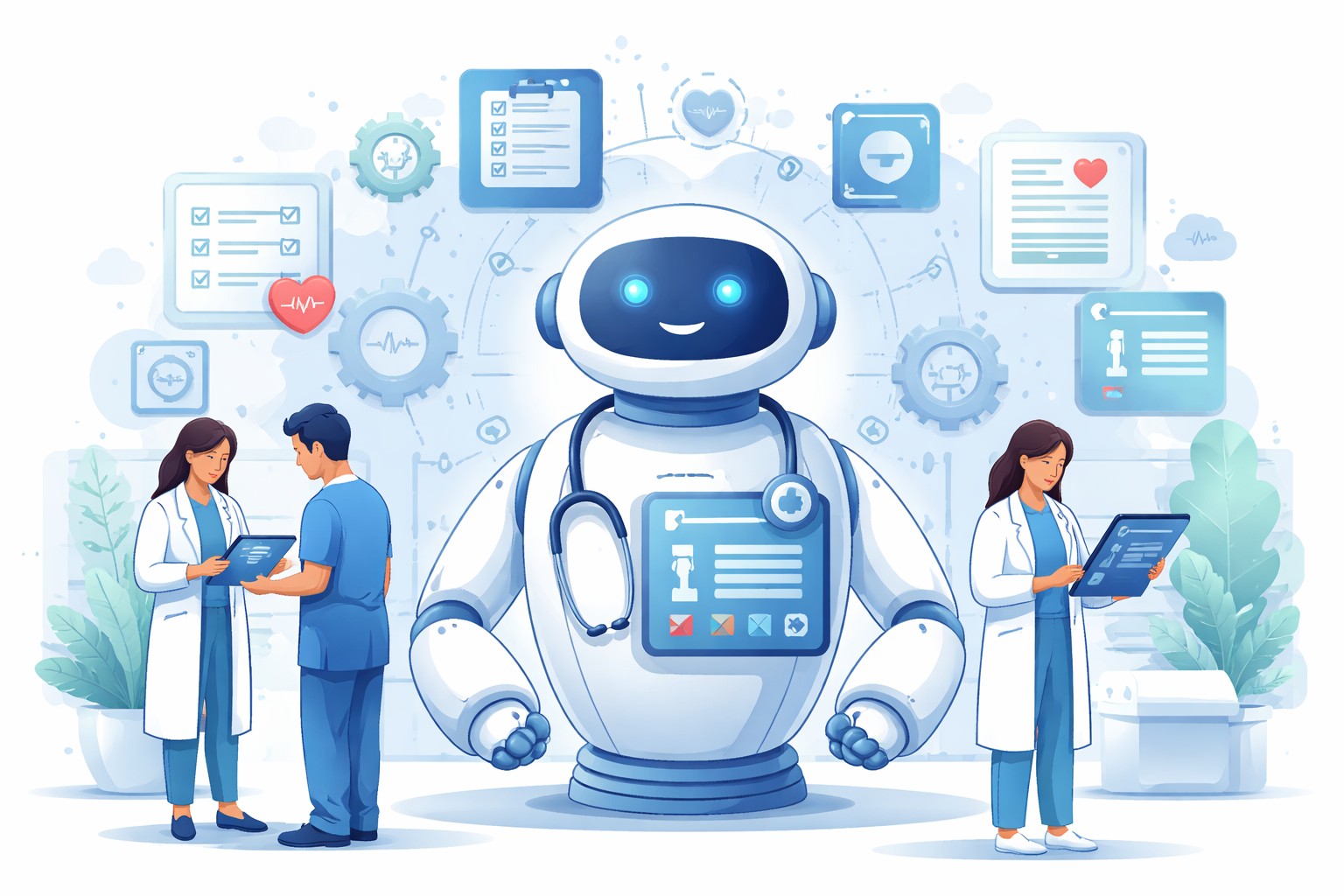
That is the type of operational friction AI agents for healthcare operations are designed to address.
What Is an AI Agent in Healthcare Operations?
An AI agent is a system built to complete objectives across multiple steps and systems.
In healthcare operations, that typically means the system can:
- Interpret structured and unstructured data
- Apply decision logic within defined policy boundaries
- Execute actions across platforms such as EHR and billing systems
- Trigger follow-up steps without waiting for manual input
- Improve over time through monitored feedback
Put simply, AI agents do more than automate isolated tasks. They move work forward across the full lifecycle of a process.
If you're exploring the architecture behind these systems, this detailed guide on the development of AI agents in 2025 explains how agent frameworks are evolving beyond rule-based automation.
Enterprise Validation: AI Agents Are Becoming Core Infrastructure
The shift toward agent-based systems isn’t theoretical. Major multinational technology companies are embedding AI agents directly into enterprise ecosystems.
For example, Microsoft has introduced enterprise-ready AI agents within its productivity stack through Microsoft Copilot, enabling contextual task automation, document reasoning, and workflow coordination across departments.
Similarly, Google Cloud’s Vertex AI platform enables organizations to build and deploy autonomous AI agents that reason over enterprise data and execute goal-oriented actions securely at scale.
When global enterprise providers treat AI agents as infrastructure, it signals a long-term structural shift, not a trend cycle.
Healthcare operations are next.
Why Healthcare Is Well-Suited for Agent-Based Systems
Healthcare IT has progressed through phases.
First came digitization. Records moved into EHR platforms.
Then came task-level automation. Scripts reduced repetitive data entry.
Now the constraint is coordination.
Operational inefficiencies often emerge from handoffs:
- Intake to eligibility verification
- Coding to claim submission
- Authorization approval to procedure scheduling
- Discharge planning to post-acute coordination
Each transition introduces delay. Each delay increases administrative cost and staff strain.
AI agents reduce the number of manual transitions required to move a workflow from initiation to completion.
Revenue Cycle: Addressing Denials at the Right Stage
Revenue cycle discussions often focus on denial management. The deeper issue is timing.
Many denials stem from preventable issues such as missing documentation attachments, modifier inconsistencies, or eligibility discrepancies. These are frequently identified only after claims are submitted.
AI agents can intervene earlier by:
- Pre-validating claims before submission
- Cross-checking documentation against payer-specific rules
- Identifying DRG or coding inconsistencies
- Initiating structured correction workflows
The benefit is not simply automation speed. It is preventing avoidable rework.
When validation moves upstream, denial volume decreases downstream.
Prior Authorization: Reducing Administrative Overhead
Prior authorization remains one of the most labor-intensive processes in healthcare operations.
Clinical documentation lives in one system.
Payer requirements evolve continuously.
Status tracking happens across multiple portals.
This fragmentation consumes staff time and delays care coordination.
AI agents can:
- Extract necessary clinical data directly from encounter documentation
- Match it against payer requirements
- Submit requests
- Monitor status updates
- Escalate cases that fall outside defined parameters
Instead of tracking every case manually, staff focus on resolving exceptions.
That shift reduces workload without increasing headcount.
Scheduling and Capacity Alignment
Hospital scheduling systems are often static, while patient demand fluctuates.
No-show rates vary by specialty.
Emergency department volume changes by time and season.
Surgical block utilization shifts.
AI agents can support:
- Predicting no-show likelihood
- Reallocating appointment slots
- Coordinating follow-up visits
- Assisting with admission forecasting in inpatient settings
Many perceived capacity constraints are, in practice, coordination constraints.
When schedules adjust dynamically, throughput improves.
Documentation and Compliance Monitoring
Administrative documentation remains a significant contributor to clinician workload.
AI agents can assist by:
- Drafting structured summaries
- Aligning documentation with coding standards
- Checking compliance formatting
- Monitoring for potential privacy risks
These systems operate within defined governance structures. Human oversight remains essential.
The objective is not replacing accountability. It is reducing repetitive administrative effort while maintaining compliance integrity.
Internal Knowledge Access
Large healthcare systems maintain extensive policy libraries, escalation pathways, and procedural guidelines.
Locating the correct guidance in time-sensitive situations is often more difficult than expected.
AI agents can:
- Retrieve context-specific policies
- Guide staff through step-by-step workflows
- Standardize execution across units
- Support onboarding and training
For organizations beginning with conversational interfaces before evolving into full autonomy, understanding how to create an AI chatbot provides a foundational step toward more advanced agentic systems.
Measuring Impact
Healthcare organizations evaluating AI agents for healthcare operations should focus on operational metrics such as:
- Claim denial rates
- Administrative cost per encounter
- Authorization turnaround time
- Staff productivity per FTE
- Patient throughput
- Overtime trends
Impact should be measured at the workflow level, not just at the tool level.
AI agents create value by reducing friction across interconnected processes.
Deployment Considerations in Healthcare
Healthcare environments are regulated, data-sensitive, and integration-heavy.
Effective deployment requires:
- HIPAA-compliant architecture
- Interoperability with EHR platforms
- Support for standards such as FHIR and HL7
- Transparent audit trails
- Defined escalation pathways
- Continuous monitoring
Leaders should evaluate where automation ends and human review begins.
This is why forward-looking healthcare organizations invest in specialized AI Agent development services that can integrate autonomy safely into regulated infrastructures.
Final Perspective
Healthcare operations rarely break because of a single failure. They slow down because of accumulated friction across steps.
AI agents represent a shift from isolated task automation to coordinated workflow execution.
For hospitals navigating staffing pressure, reimbursement complexity, and compliance demands, reducing handoffs may have more impact than adding another analytics layer.
The systems that move work forward, rather than simply report on it, are likely to shape the next phase of healthcare operations.







Leave a Reply