
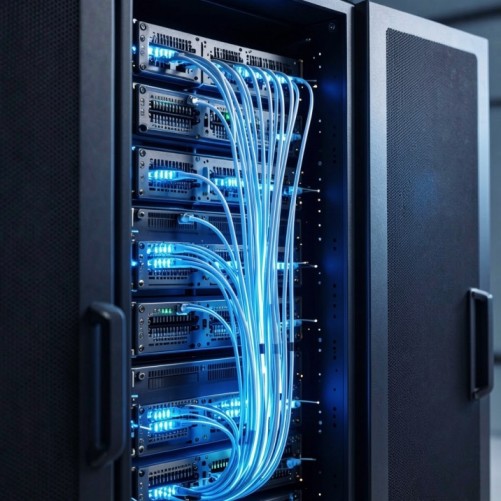

Every AI-generated response, fraud warning, medical image assessment, route recommendation, or factory prediction begins far below the application visible to the user. Processor clusters execute calculations, data systems supply context, networks transfer information, and power and cooling equipment keep the entire process available.
Discussion around artificial intelligence often centers on models, assistants, and automated agents. Operational value, however, depends on whether those capabilities can function securely, repeatedly, and at an acceptable cost. A promising demonstration may run successfully with temporary cloud resources. Services used across hospitals, banks, factories, public agencies, or millions of connected devices require a much more dependable foundation.
AI infrastructure now influences which organizations can progress beyond experimentation, where advanced workloads can operate, and whether digital services remain responsive under sustained demand. Its role extends beyond supporting individual AI tools. It provides the computing foundation on which a growing share of modern economic activity will run.
AI Performance Begins Beneath the Application Layer
Conventional business software usually processes predictable requests across general-purpose servers. Modern AI workloads behave differently. Training can require datasets and model parameters to be distributed across hundreds or thousands of processors, while inference must deliver results quickly enough for people, machines, and operational systems to act on them.
Managing these requirements depends on distributed training architectures that coordinate computation, memory, storage, and communication across multiple machines. Faster processors help, but hardware alone cannot prevent bottlenecks. Limited network capacity can leave accelerators waiting for data. Slow storage can interrupt training cycles, while weak workload scheduling can increase processing time and operating costs.
Inference introduces another set of pressures. Customer support systems may face sudden demand peaks. Computer vision platforms process continuous video. Clinical applications need consistent response times, while industrial systems may have to operate without interruption. Each use case creates a different balance between speed, capacity, location, security, and cost. Infrastructure choices consequently influence model performance, deployment timelines, service availability, and the range of applications an organization can support.
Advanced models may attract attention, but the systems beneath them determine whether their capabilities remain controlled demonstrations or develop into reliable digital services.
What Keeps an AI Workload Running
AI infrastructure is not defined by a single data center, cloud service, or semiconductor. It operates as a connected environment in which each component affects the productivity of the others. Many organizations combine public cloud resources, private systems, dedicated clusters, and regional facilities through hybrid cloud strategies designed around workload sensitivity, governance, and performance requirements.
Four layers carry most production AI workloads:
- Compute and memory: GPUs, CPUs, tensor processors, high-bandwidth memory, and specialized accelerators perform training and inference. Cluster design matters alongside processor volume because large numbers of chips must exchange information without creating communication delays. Purpose-built AI accelerators are designed for the parallel, data-intensive calculations required by modern workloads.
- Data and storage: Training datasets, embeddings, model checkpoints, vector databases, system logs, and operational records must remain available at the required speed. Data lineage, quality, retention, and residency rules also influence where information can be stored and how it can move.
- Networking and orchestration: High-speed interconnects coordinate processors inside computing clusters, while wider networks connect cloud regions, enterprise systems, and end users. Scheduling tools distribute workloads, manage scarce resources, and prevent costly hardware from remaining idle.
- Power and thermal management: Dense processor racks require substantial electricity and produce concentrated heat. Grid connections, backup power, liquid cooling, water availability, and facility layout have therefore become core design considerations.
Weakness in one layer constrains the entire environment. Processors without sufficient networking create congestion. Storage without governance creates operational complexity. Facilities without adequate power or cooling cannot support high-density systems.
Useful capacity only emerges when hardware, data, networking, software, and physical infrastructure operate as one coordinated system.
Compute Access Separates Pilots from Production
Reliable computing capacity increasingly determines whether an AI project can move beyond a limited trial. Organizations with sufficient access can customize models, automate processes, analyze large datasets, and run intelligent services continuously. Those without it remain dependent on intermittent capacity, restricted workloads, or external platforms that may not meet their performance and governance needs.
Different stages of deployment require different forms of infrastructure.
- Frontier-scale capacity supports foundation model training and other highly intensive workloads. Building at this level requires advanced processors, high-speed networking, dependable energy, specialized engineering, and tightly integrated systems.
- Enterprise-scale capacity supports model customization, retrieval systems, analytics, governance, and application deployment. Flexibility matters because infrastructure demand can change quickly when a pilot expands across business functions.
- Distributed capacity places inference closer to factories, vehicles, hospitals, telecommunications networks, and connected devices. Local processing can reduce latency, limit unnecessary data transfers, and allow important functions to continue when access to a central facility is interrupted.
Microsoft’s Fairwater facility in Wisconsin illustrates the architectural shift at the upper end of the stack. Rather than treating servers as independent units, the facility was designed as a coordinated AI computing system in which processors, networking, storage, and physical infrastructure support shared workload requirements.
Facilities designed around this principle show why compute access is moving closer to the center of organizational strategy. Infrastructure is no longer a back-office resource acquired after a digital plan has been approved. Available capacity increasingly determines what that plan can realistically include.
Physical Constraints Now Shape Digital Ambition
AI workloads may operate digitally, but the facilities supporting them remain constrained by physical conditions. Suitable locations need land, grid access, fiber connections, cooling resources, equipment supply chains, skilled labor, and regulatory approval. Securing these elements can take longer than procuring the processors.
- Location affects performance and continuity: Latency-sensitive services benefit from operating near users or data sources. Regulated information may need to remain within a particular country or region. Concentrating capacity in a small number of locations can also increase exposure to electricity disruption, network failure, natural hazards, and permitting delays. Similar priorities influence the development of AI data center capacity in countries such as Japan, where high-density computing must be balanced with cooling requirements, domestic processing needs, and control over sensitive workloads.
- Energy affects where capacity can be built: AI clusters need dependable electricity and cooling from the moment they begin operating. Grid connection timelines, local generation, backup systems, and facility efficiency can determine whether planned capacity becomes usable. Google and Intersect’s Meitner Energy Center in Texas provides an operational example. The project places a new data center alongside dedicated energy generation, connecting computing expansion with the power supply required to support it.
- Infrastructure geography affects digital autonomy. Organizations need to know where data is stored, where models are executed, and which legal or operational dependencies apply. Local or regional capacity can support sensitive workloads, reduce exposure to distant network routes, and give institutions greater control over continuity planning.
AI deployment is therefore inseparable from decisions about land, energy, connectivity, and jurisdiction. Software may move instantly, but the infrastructure behind it cannot.
Reliability Matters More Than Raw Capacity
Large clusters can increase processing output, but they also increase the effect of network failures, software faults, cyber incidents, cooling problems, or electricity interruptions. Capacity without resilience creates a larger point of failure.
Dependable AI infrastructure requires several operating principles:
- Interoperability: Workloads should move between public cloud platforms, private systems, regional facilities, and edge environments without extensive rebuilding.
- End-to-end visibility: Operators need to observe processors, models, storage, networks, data pipelines, response times, energy use, and failure conditions through a connected monitoring environment.
- Security by design: Identity controls, encryption, workload segmentation, model access policies, audit trails, and hardware supply chain checks must extend across every layer.
- Energy-aware scheduling: Not every workload needs the most powerful processor or the same response time. Tasks can be allocated according to urgency, resource availability, cooling demand, and electricity conditions.
- Geographic resilience: Distributed capacity can reduce dependence on one facility or network route. Critical services should be designed to continue at a reduced level rather than stop completely.
Continued generative AI adoption will convert occasional model use into recurring requirements for inference, storage, orchestration, monitoring, and governance. AI agents deepen that pressure because they can initiate multiple model calls, retrieve information, access tools, and complete several steps within one workflow.
Infrastructure teams will consequently be assessed less by the volume of hardware installed and more by the availability, utilization, security, and adaptability of the capacity they manage.
Building the Foundation for the Next Digital Era
Visible AI capabilities may reside in models and applications, but their economic reach depends on what exists beneath them. Computing capacity, governed data, resilient networks, sufficient electricity, and geographically distributed facilities determine whether intelligent services can progress from promising prototypes to dependable operating systems.
Future digital leadership will not be secured through advanced algorithms alone. It will depend on infrastructure that makes intelligence available without compromising security, resilience, or energy discipline.
Digital inequality in the AI era may therefore be defined less by access to software and more by access to reliable computing capacity. Organizations and regions capable of building, connecting, powering, and governing that capacity will be better positioned to convert technical progress into sustained operational value.
Conclusion
AI may be experienced through models, applications, and automated services, but its long-term value depends on the infrastructure supporting them. Compute availability, governed data, high-speed connectivity, dependable energy, and resilient facilities determine whether AI can move from limited experimentation into secure, continuous, and large-scale operation.
The next phase of the digital economy will be shaped by those that treat AI infrastructure as a core operational foundation rather than a secondary technology investment. Reliable capacity will determine how quickly new services are introduced, how widely they can be accessed, and how confidently businesses and institutions can depend on them.








Leave a Reply