

Ask a team that ran an industrial IoT pilot how it went and you'll usually hear that it went well. Ask what happened next and the answer gets shorter. McKinsey puts the share of manufacturers stuck at the pilot stage at around 70%, held back by cost, security, interoperability and installation problems. Bain looked at it from another angle and found that roughly four in five companies actively testing IoT turn fewer than 60% of their pilots into production systems.
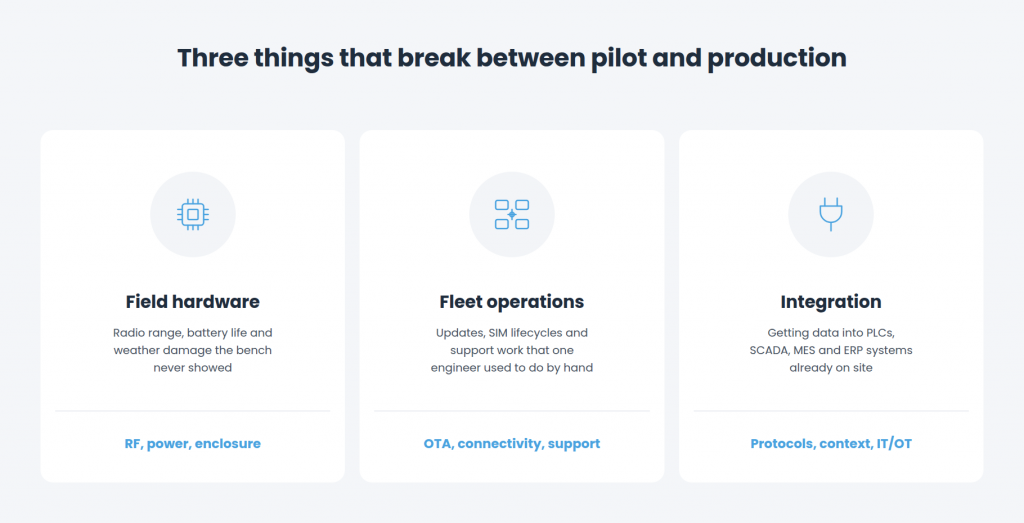
The industry calls this pilot purgatory. Fair enough as a label, but it names the outcome without saying what caused it. For anyone doing IoT development, a narrower question is more useful. What specifically stops working when a deployment grows from 50 devices to 50,000? The answers tend to cluster in three places: the hardware, the cost of running a fleet, and integration with the systems a site already has.
Field conditions expose hardware the bench never tested
Pilots get installed wherever it's convenient. Someone picks a site near the office, with decent Wi-Fi and a helpful facilities manager, and runs it for a few weeks. That's a reasonable way to prove a concept. It also means the environment most likely to break the hardware is the one the pilot avoids. Three problems tend to stay hidden until rollout. (If you want a refresher on sensor types first, JTT's guide to IoT sensors covers the basics.)
Datasheet radio range assumes nothing is in the way
Published range figures are measured in open space. A factory or warehouse is full of reinforced concrete, steel shelving and metal enclosures that behave like leaky Faraday cages. A 2.4 GHz link that looks perfect on the bench can vanish two walls later. Sub-GHz bands get through structure better, but you give up bandwidth for it. No formula tells you in advance which result you'll get. You find out with a site survey that records RSSI and SNR at every spot where a device will actually be mounted.
Battery life depends on the radio and the temperature
A device draws many times more current while transmitting than at rest, so duty cycle decides field lifetime far more than rated capacity does. Then chemistry gets involved. Lithium-thionyl-chloride cells cope well with temperature swings, but their voltage sags when the radio fires a sudden pulse. Ordinary Li-ion loses capacity in the cold and must not be charged below 0°C. Put a battery specified for five years at 25°C into an unheated building where it transmits on every alarm, and those five years become a guess.
Environmental damage builds up slowly
Water ingress, corrosion and short circuits cause most field failures in outdoor electronics. That's why outdoor sensors and EV chargers rely on conformal coatings (parylene, acrylic, silicone or urethane) and properly rated enclosures, and why DC fast chargers shut themselves down on cooling or thermal faults. Heat wears components out faster along an Arrhenius curve. Vibration cracks solder joints over months. A six-week pilot simply doesn't run long enough to see any of it.
The costly result of all three is a status screen that says everything is fine when it isn't. EV charging shows this clearly. In ChargerHelp's data, a network can list its chargers as available while only 71% of charging attempts work the first time. Both numbers describe the same equipment, and the pilot is where the green number looks most believable.
So put the pilot in the worst site you have. Then instrument those units properly: RSSI, battery voltage under load, internal temperature, and how often each device resets.
Running a fleet costs money a pilot never records
Nobody tracks operating cost during a pilot, because the work behind it is done by hand and nobody notices it. Fifty units in one building get reflashed over a lunch break, watched on one dashboard and swapped by the engineer who installed them. That's one person doing chores, and it falls apart once the fleet outgrows what one person can physically reach. Three costs cross that line, usually after the hardware has already shipped.
Firmware updates need a proper delivery system
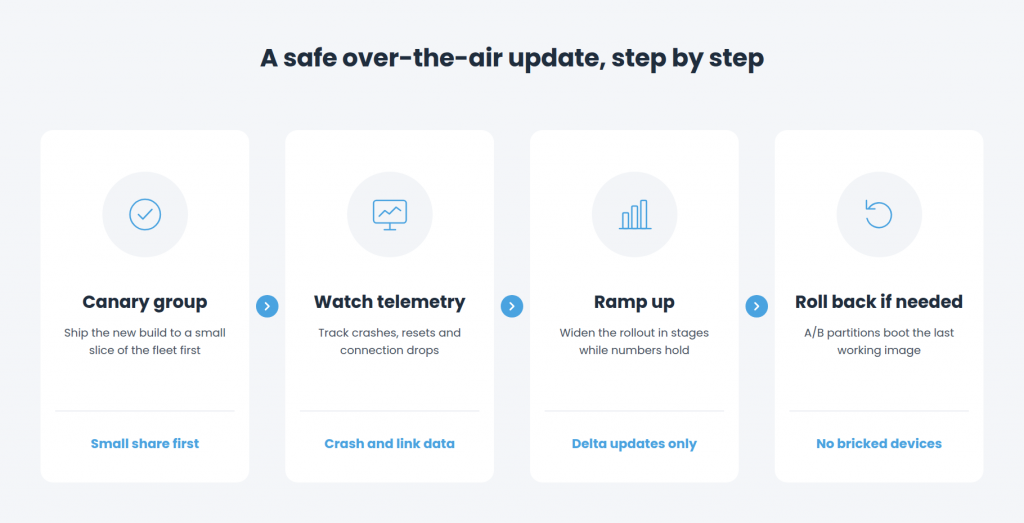
Flashing over USB or the local network works for a dozen devices and tells you nothing about updating 30,000. A production over-the-air system needs properties a pilot never tests. Rollouts should be staged: send the build to a small canary group, watch crash and connectivity telemetry, then widen it. A bad image pushed to everyone at once is an outage, and a big one. Installs should be atomic with rollback, usually through A/B partitions, so a failed update boots back into the last working version instead of bricking a unit on a rooftop nobody can get to. Updates should also ship as deltas that contain only the changed bytes. A full multi-megabyte image over metered cellular, multiplied by tens of thousands of devices, ends up as a line item finance will ask about.
Connectivity is a ten-year commitment
Choosing a radio module feels like a one-off hardware decision. In practice you're betting on how long a network will stay alive. The 2G and 3G shutdowns make the point. By December 2025 the Global mobile Suppliers Association (GSA) had tracked more than 300 legacy network shutdowns that were completed, planned or underway across 88 countries. In the US, T-Mobile pushed back its 2G switch-off twice before starting a phased retirement in February 2025. In France, the national elevator federation asked regulators for a delay because about 232,000 lifts still depend on 2G for their emergency link, and every one of them is a regulated safety device.
Today's options come with clear trade-offs. NB-IoT is cheap and gets through concrete well, but it can't handle large OTA payloads or devices that move. LTE-M costs more and copes with both. Carrier-managed eSIM with remote provisioning under GSMA's SGP.32 specification turns a future network change into a software job instead of a technician visit to every site. (JTT's piece on 5G IoT connectivity looks at where cellular is heading next.)
Migrations forced by a shutdown deadline are widely reported to cost much more than planned ones, since years of lead time get squeezed into months. The exact premium varies too much by fleet and region to quote one figure, but nobody disputes the direction. Model the connectivity lifecycle before the pilot, not after the carrier's notice arrives.
Support costs rise as the fleet ages
Public EV charging shows the support problem most plainly. ChargerHelp's 2025 reliability report covered more than 100,000 charging sessions on 2,400 chargers. Reported network uptime was above 98%. First-attempt success was about 71%. New stations succeed around 85% of the time, and by year three that drops to roughly 70%. Close to a third of attempts fail on chargers the dashboard shows as available. A pilot fleet won't reveal this, because every pilot unit gets individual attention that production units never will.
At scale you need a unique identity for every device (usually an X.509 certificate installed at manufacture), a way to rotate or revoke credentials remotely, and an actual budget for the support staff that the long tail of problems will need.
Before anything ships, build a cost-per-device-per-year model covering connectivity, device management and support. Then check whether the value each device delivers still covers that cost at a thousand times the pilot's size.
Integration with existing systems is where IoT development stalls
A pilot can send clean readings to a dashboard and look done. What it usually skips is the part that decides whether the project scales: getting that data into the systems the plant already runs on. Industrial sites are almost always brownfield. There are PLCs, SCADA, a historian, an MES, an ERP and decades of serial-connected equipment, and the new IoT layer has to work alongside all of it.
Most of the work is protocol translation
Plant data rarely shows up as a tidy REST call. It comes over Modbus, PROFINET, EtherNet/IP and old serial links, each with its own habits. OPC UA has become the usual way to bridge them. Current brownfield reference designs use edge gateways to map proprietary controllers such as the Siemens SIMATIC S7-1500 into a standard OPC UA address space. Semiconductor fabs are adopting it at scale, and equipment makers including Applied Materials, Lam Research, Tokyo Electron and ASML increasingly ship native support. Vendors in this space often quote integration costs 50 to 70% lower than building a custom interface for each tool. That's exactly the cost that sinks a pilot when nobody plans for it. Doing some of this processing close to the machines helps too, and JTT's overview of edge computing explains why.
A raw value means nothing until it has context
A register read like 40001 = 72 tells you nothing by itself. Someone has to attach the asset it came from, the engineering unit and the scaling factor. The Unified Namespace pattern deals with this: a single MQTT broker serves as the shared, contextualised source of truth that OT and IT systems both publish to and read from, usually organised with Sparkplug B birth and death certificates over an ISA-95 asset hierarchy.
Practitioners now warn against the shortcut of pumping raw OT data straight into a cloud data lake. It feels fast during a pilot and turns into an expensive heap of data nobody reuses once the fleet grows. Decide on purpose where contextualisation happens (at the edge, in the broker, or further downstream) before data volume decides it for you.
The IT/OT boundary is a security decision
Connecting plant equipment directly to the cloud removes network segmentation that exists for good reasons. A production design keeps the boundary with an edge gateway, a DMZ and controlled northbound data flows along Purdue-model lines, so adding a sensor never quietly puts a PLC on the internet. Retrofitting that separation after a flat pilot network has gone live costs far more than designing it in from day one.
What to settle before the pilot starts
A pilot that works and a deployment that survives 50,000 units are answering different questions, and most projects fall into the gap between them. The ideas rarely get worse at scale. Usually the decisions that matter at scale just never got made while the design was still cheap to change. That's the real job of a pilot in IoT development: forcing answers to fleet-sized questions before the fleet exists.
What a device costs over its whole life
Don't project unit economics from a handful of free pilot units. Model them close to full fleet size, with multi-year connectivity costs and sunset risk, device management, and the support staff the problem tail will eventually need. Ten devices hide precisely the costs that appear at ten thousand.
Which number you'll trust
An uptime dashboard and first-attempt success telemetry can describe the same fleet in very different terms, and only one of them matches what users go through. Run the pilot somewhere hostile, instrument it to capture failures, and agree now that the harder number is the one you'll act on later. The distance between 98% uptime and 71% real success in EV charging is what you get when nobody makes that call on purpose.
How data gets to the rest of the business
A sensor feeding a dashboard proves nothing about integration. Before scaling, work out how field protocols get translated into your data layer, where tags pick up their context before they reach enterprise systems, and how the IT/OT boundary stays intact. Each of these is cheap to change during a pilot and painful to retrofit once thousands of devices depend on it.








Leave a Reply