
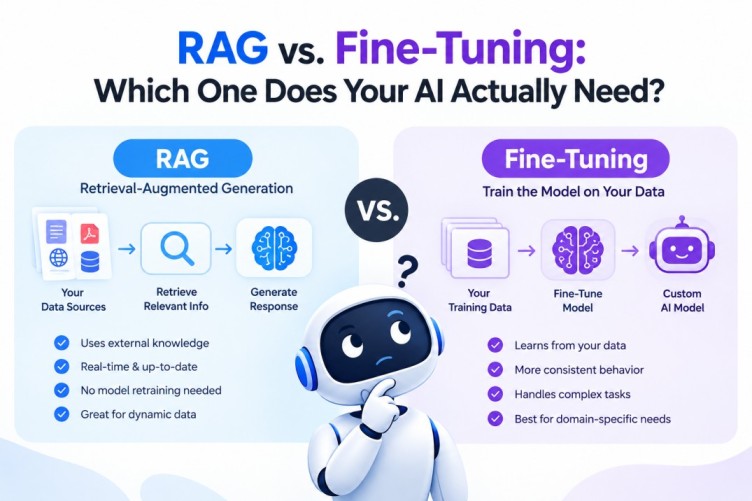

As businesses move past experimenting with off-the-shelf AI tools and start building products meant to handle real, domain-specific work, one question comes up almost immediately: should the AI be fine-tuned on the business's own data, or should it retrieve relevant information from a knowledge base at the moment it's needed? These two approaches, fine-tuning and retrieval-augmented generation (RAG), are often presented as competing options, when in practice they solve different problems and, in many real deployments, work best together rather than as a strict either-or choice.
Understanding the actual difference between these two approaches matters because choosing the wrong one for a given use case tends to produce a predictable set of frustrations: a fine-tuned model that confidently states outdated information, or a RAG system that retrieves the right documents but still struggles to communicate in the tone or format the business actually needs. This article breaks down what each approach does, where each one genuinely earns its keep, and how to think about the decision for a specific project.
Custom AI Model Training and Why This Decision Comes Up So Early
This question tends to surface at the very beginning of an AI project, often before a business has even settled on which base model to use, because it shapes almost every downstream decision, data preparation, AI infrastructure, cost, and ongoing maintenance, all of which look different depending on which path is chosen. Getting a clear answer early avoids a common and expensive mistake: investing heavily in custom AI model training for a problem that retrieval could have solved more simply, or conversely, building an elaborate retrieval pipeline for a problem that really needed the model itself to be adapted.
The confusion is understandable because both approaches aim at the same broad goal, making a general-purpose AI model behave more usefully for a specific business context, but they achieve it through fundamentally different mechanisms, with different strengths, weaknesses, and cost profiles.
What Fine-Tuning Actually Does
Fine-tuning takes a pretrained model and continues training it on a smaller, curated dataset specific to a business's domain, task, or desired behavior. This process adjusts the model's internal parameters, meaning the knowledge and behavioral patterns from the fine-tuning data become baked into the model itself, rather than being retrieved from an external source at the time of use.
This makes fine-tuning particularly well-suited to teaching a model how to behave, adopting a specific tone of voice, following a particular response format, handling a specialized task like classifying support tickets into internal categories, or reasoning through a domain-specific workflow that doesn't map cleanly onto general knowledge. A fine-tuned customer support model, for example, can learn to consistently respond in a company's brand voice, correctly interpret internal jargon, and follow the specific escalation logic a business uses, because that behavior has been trained directly into the model's weights.
Fine-tuning has real limitations, though. The knowledge embedded during training is fixed at the point the fine-tuning process ends, if a business's product catalog, pricing, or policies change the following week, the fine-tuned model won't automatically know about that change unless it's retrained. Fine-tuning also requires a reasonably well-prepared dataset, computational resources for training, and ongoing retraining cycles to stay current, all of which add cost and complexity relative to simply plugging in fresh data at query time.
What Retrieval-Augmented Generation Actually Does
RAG takes a different approach entirely. Rather than modifying the model itself, a RAG system retrieves relevant information from an external knowledge source, a document database, internal wiki, product catalog, or CRM, at the moment a query comes in, and feeds that retrieved information to the model as additional context alongside the user's question. The model then generates a response grounded in that freshly retrieved information, rather than relying solely on what it learned during its original training.
This architecture makes RAG particularly strong for use cases where accuracy and currency of information matter more than behavioral customization: a legal research assistant that needs to reference the most recent version of a regulation, a customer support agent that needs to pull the exact current price of a product, or an internal knowledge assistant that needs to answer questions based on documents that get updated weekly. Because the underlying model isn't retrained every time the source data changes, updating a RAG system's knowledge is often as simple as updating the documents in its retrieval index, without touching the model itself.
RAG isn't without its own trade-offs. The quality of a RAG system's answers depends heavily on the quality of its retrieval step. If the system fetches irrelevant or incomplete documents, the model's response will reflect that, no matter how capable the underlying model is. Building an effective RAG pipeline also requires infrastructure most businesses don't have out of the box: a properly chunked and indexed knowledge base, an embedding model to convert text into a searchable vector format, and a vector database to store and query those embeddings efficiently.
Where Fine-Tuning Tends to Win
Fine-tuning tends to be the better choice when the goal is to change how a model behaves rather than what it knows. Businesses that need an AI system to consistently follow a specific format, generate structured reports in a particular style, or classify inputs according to an internal taxonomy that doesn't exist in any general-purpose training data generally see stronger results from fine-tuning than from retrieval alone, since no amount of retrieved context reliably teaches a model a new behavioral pattern the way targeted training does.
Fine-tuning also tends to work well for narrow, stable tasks where the underlying knowledge doesn't change frequently. A model trained to interpret a specific type of technical document, understand an industry's specialized terminology, or perform a consistent classification task benefits from having that pattern embedded directly, particularly when the task needs to run at scale with very low latency, since a fine-tuned model doesn't need to perform a retrieval step before generating a response.
Highly regulated or specialized domains, where responses need to consistently reflect a particular reasoning style or compliance-aware phrasing, are another area where fine-tuning tends to produce more reliable, repeatable results than retrieval alone.
Where RAG Tends to Win
RAG is generally the stronger choice when the core problem is keeping an AI system's answers accurate and current against a body of information that changes regularly. A customer support system that needs to reflect this week's pricing and inventory, an internal assistant that needs to answer questions against constantly updated policy documents, or a research tool that needs to cite the most recent available sources are all cases where RAG's ability to pull fresh information at query time is a significant advantage over a model whose knowledge was frozen at the last training run.
RAG also tends to be the more practical starting point for businesses with large, existing document repositories they want an AI system to draw on, internal wikis, contract archives, product documentation, since building a retrieval pipeline around existing content is often faster and cheaper than curating a fine-tuning dataset from the same material. It's also generally easier to audit and explain: because a RAG system can surface which specific documents it retrieved to generate an answer; it's more straightforward to trace why the model responded the way it did, which matters in contexts where accountability and traceability are important.
Why the Two Approaches Often Work Best Together
In practice, many of the most effective production AI systems combine both approaches rather than choosing one exclusively. A common pattern is fine-tuning a model to handle tone, format, and task-specific reasoning, while layering RAG on top to supply current, factual information the model wouldn't otherwise have access to. This gives a business the behavioral consistency and specialized reasoning that fine-tuning provides, combined with the up-to-date accuracy that retrieval delivers.
This combined approach is one of the areas where working with a team experienced in AI agent development services becomes particularly valuable, since designing a system that intelligently balances fine-tuned behavior with real-time retrieval, deciding what should be trained into the model versus what should be retrieved dynamically, requires a level of architectural judgment that goes beyond simply picking one technique off a menu. Getting this balance wrong in either direction tends to produce a system that's either too rigid to stay accurate over time or too dependent on retrieval quality to behave consistently.
Questions to Ask Before Choosing an Approach
A few practical questions tend to clarify which direction makes more sense for a specific project. Does the information the AI needs to work with change frequently, or is it relatively stable over time? Frequently changing information generally favors RAG, since retraining a model every time source data shifts is expensive and slow.
Is the core challenge getting the model to behave a certain way, or getting it to know certain facts? Behavioral consistency, tone, format, specialized reasoning patterns tend to favor fine-tuning, while factual accuracy against a large, evolving knowledge base tends to favor RAG.
What does the existing infrastructure look like? A business with a large, well-organized document repository already has much of what's needed for a RAG pipeline, while a business with a well-labeled dataset of example interactions may be better positioned to fine-tune effectively.
What are the latency and cost constraints? RAG systems introduce an additional retrieval step before generation, which can add latency compared to a fine-tuned model responding directly, a factor worth weighing for high-volume, real-time use cases.
Conclusion
Fine-tuning and RAG solve genuinely different problems, and treating them as interchangeable options tends to lead to disappointing results regardless of which one gets chosen. Fine-tuning is generally the stronger choice for shaping how a model behaves, tone, format, and specialized reasoning on relatively stable knowledge, while RAG is generally the stronger choice for keeping responses accurate against information that changes frequently. Many of the most effective real-world systems don't choose one over the other at all, but combine fine-tuned behavior with retrieval-based accuracy to get the benefits of both. Businesses evaluating this decision are best served by starting from the specific problem they're trying to solve, behavioral consistency or factual currency, rather than defaulting to whichever technique happens to be more heavily marketed at the moment.






Leave a Reply